

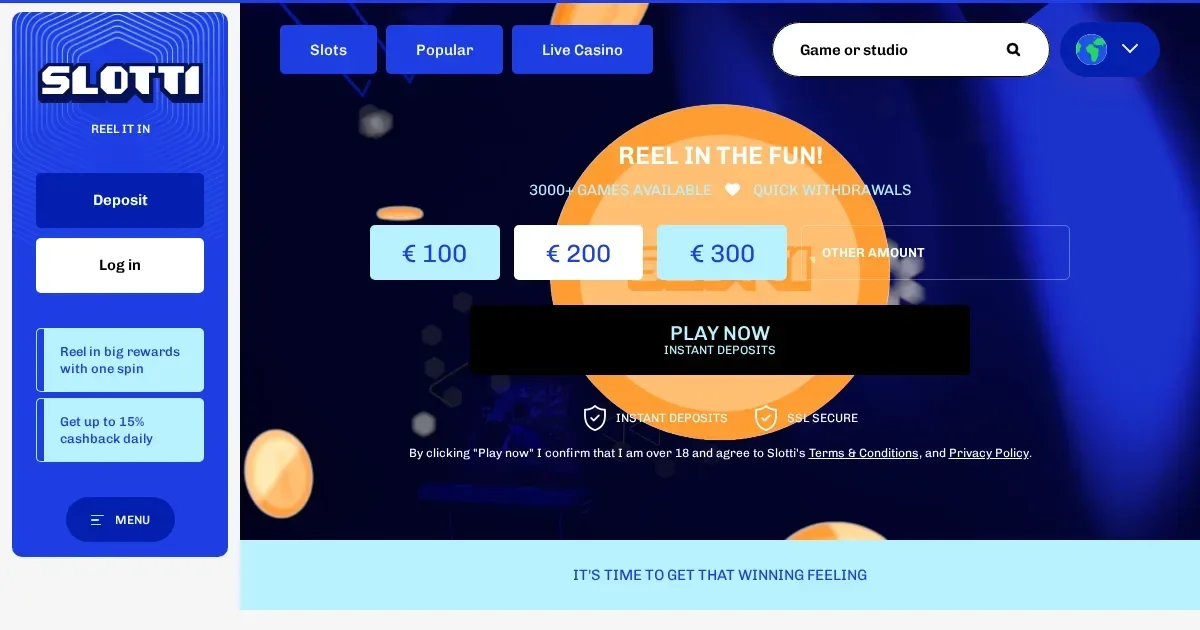
Gambling should always be entertainment, not something that causes stress or financial pressure. Slotti provides tools to help you stay in control, and this page brings together the practical steps you can take – both on the platform itself and through UK support services – to keep things enjoyable.
Why responsible gambling matters
Betting or playing for real money can be fun when it stays within limits you set for yourself. Problems start when gambling stops being a choice and becomes a way to chase losses, escape worries, or solve money troubles. Recognising the line early makes all the difference.
Operators like Slotti exist to provide entertainment, but they also have a role in giving you the tools to manage your own play. UK law requires them to promote safer gambling, and that includes offering deposit limits, self-exclusion and access to independent help.
When gambling stops being fun
A few signs that your gambling might be getting out of hand:
- Spending more than you planned or can afford
- Chasing losses – trying to win back what you've lost
- Lying to friends or family about how much you gamble
- Gambling to escape stress, anxiety or boredom
- Neglecting work, relationships or other responsibilities
- Borrowing money to gamble or getting into debt
If any of these feel familiar, it's worth taking a step back and thinking about the role gambling plays in your life.
A short self-check
Ask yourself these questions honestly. There's no scoring system here – they're simply prompts to reflect on your habits:
- Do you gamble for longer than you intended?
- Have you tried to cut down or stop, but found it difficult?
- Does gambling interfere with your day-to-day life?
- Do you feel restless or irritable when you try to stop?
- Have you borrowed money or sold possessions to fund gambling?
- Do you gamble to distract yourself from problems or negative feelings?
- Have you lied about the amount you gamble?
- Has your gambling caused arguments with people close to you?
If you answered yes to several of these, it may be time to seek support or set stricter limits on your play.
The operator's deposit and time controls
Slotti gives you several ways to manage your activity directly from your account:
| Tool | What it does |
|---|---|
| Deposit limit | Set a cap on how much you can deposit over one day, one week or one month |
| Betting limit | Restrict the total you can wager over one day, one week or one month |
| Loss limit | Set a ceiling on how much you can lose over one day, one week or one month |
| Self-ban / Time out | Exclude yourself from the platform for a set period or indefinitely |
Worth remembering: relaxing or removing a limit you've set requires a 48-hour cooling-off period. That delay is there to give you time to reconsider before loosening the restriction.
These tools are straightforward to use, but they only work if you set them before things feel difficult. Deciding on a weekly deposit cap when you're calm is easier than trying to impose one after a bad session.
National help lines and organisations
Professional support is available across the UK, and it's confidential and free. You don't need to be in crisis to reach out – even if you're simply wondering whether your gambling is becoming a problem, these services can help.
GamCare
GamCare runs the National Gambling Helpline, available 24 hours a day, seven days a week. Call 0808 8020 133 for free, confidential advice and support. The service is staffed by trained advisers who understand gambling harm and can help you work out your next steps. Visit gamcare.org.uk for online chat and self-assessment tools.
BeGambleAware
BeGambleAware provides information, advice and access to treatment services. Their site at begambleaware.org includes a directory of local support options, self-help guides, and links to counselling services across England, Scotland and Wales.
GamStop
GamStop is a free national self-exclusion scheme that blocks your access to all UK-licensed gambling sites. Once you register at gamstop.co.uk, you'll be excluded for a minimum of six months, with options for one year or five years. The ban covers online casinos, betting sites and bingo platforms licensed by the UK Gambling Commission.
Gordon Moody
Gordon Moody offers residential treatment programmes and online therapy for people seriously affected by gambling. It's a registered charity providing intensive support for those who need more than a helpline conversation. Learn more at gordonmoody.org.uk.
Blocking software
If you want to prevent access to gambling sites across all your devices, two widely used options are:
- Gamban (gamban.com) – paid software that blocks gambling sites and apps on computers, tablets and phones. It's difficult to uninstall once active, which makes it effective if you're serious about taking a break.
- BetBlocker (betblocker.org) – a free, multi-platform tool that does much the same job. It works on Windows, Mac, Android and iOS, and can be set to block for a fixed period.
Both tools are more robust than browser extensions, which can be easily disabled. They won't stop someone determined to bypass them, but they do create a barrier that gives you time to reconsider.
Protecting minors
Access to gambling sites is restricted to those aged 18 and over (18+). If you share a device with someone under 18, consider using parental-control software such as Net Nanny or Qustodio to block gambling content entirely. Most internet service providers also offer free parental controls that can be enabled through your account settings.
Never share your login details with anyone, and log out of your account when you've finished playing – especially on shared computers or tablets.
Tips for gambling sensibly
A few practical habits that help keep things in perspective:
- Set a budget before you start – decide how much you can afford to lose, and stick to it.
- Treat it as entertainment, not income – the house always has an edge, so think of gambling as paying for the experience, not a way to make money.
- Take regular breaks – step away from the screen every so often, even if you're winning.
- Don't chase losses – if you've lost what you planned to spend, stop. Trying to win it back usually makes things worse.
- Never gamble when you're upset, stressed or under the influence – decisions made in that state are rarely good ones.
- Keep gambling separate from other parts of your life – don't let it interfere with work, family time or other hobbies.
If you have questions about the content on this site or need help navigating the information here, you can reach the editorial team at [email protected]. For questions about your account, deposits, withdrawals or gameplay, contact the operator's own support channels directly through the platform.
This content is provided for information and marketing purposes. We are not a gambling operator, bookmaker or organiser of betting or gaming activity. This site is restricted to visitors aged 18 and over (18+). Free, confidential support with gambling is available at BeGambleAware.org.